

What changed in 2026
Since 1 June 2026 a new road safety law has been in force in Serbia — the biggest reform in ten years. The practical changes for a driver: the five-thousand-dinar minimum fines are gone and minor offences now cost noticeably more. The option to pay half within eight days has been abolished: the discounted window no longer exists. New offences have been added, and penalties for serious breaches have multiplied.
Alcohol and serious offences
The permitted alcohol level remains the same — up to 0.2 per mille, but the penalty for exceeding it has risen sharply. A slight excess starts with a fine of thirty thousand dinars, and at a significant excess the amounts reach two hundred thousand with mandatory withdrawal of the driving licence for six months. A separate requirement has been introduced to install an alcohol interlock in school buses and driving-school vehicles: from 1 September 2026 this is mandatory equipment, rolled out in two phases. Driving schools must also keep a digital record of every driving lesson with coordinates and times — oversight is stricter, and disputes about lessons not delivered are settled with data.
How a fine arrives
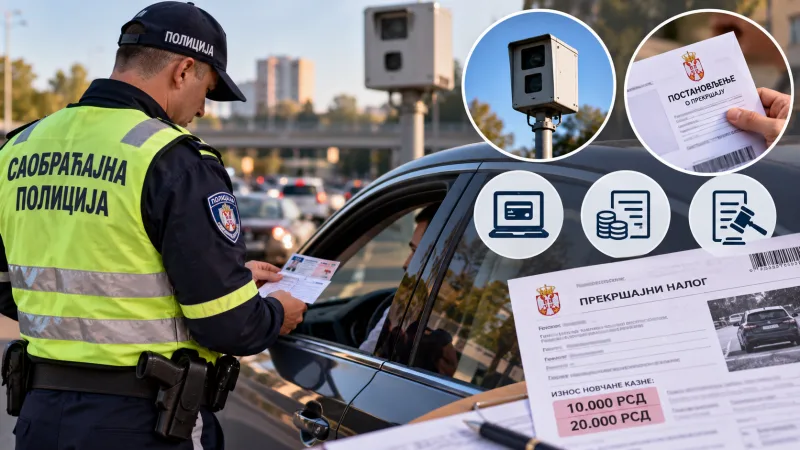
An offence is usually handled by a misdemeanour order, which the police issue on the spot or send by post if a camera recorded it. The order states the amount, the description of the offence and the deadline. Then there are two options: pay, or file a request for a court decision, that is, contest it. If neither is done within the period allowed, the person is deemed to have accepted liability and the order becomes final — the amount is then collected by enforcement.
Where to pay
Payment is made in several ways: by bank transfer using the details on the order, through the post office, or via electronic services. In a transfer it matters to enter the model and reference number from the document correctly — otherwise the payment will not be credited and the debt remains. Keep the payment confirmation: in disputes it settles the question fastest. If the amount looks inflated or the offence is not yours, documents and camera footage should be requested immediately, while the data is available.
Parking and municipal fines
Parking fines are a separate category, issued by the city parking service. There the logic is its own: a fine arrives for unpaid parking in a zone, and in serious cases the car is towed and recovery costs extra time and money. Municipal and utility services also fine for breaching upkeep rules, dumping waste in the wrong place and parking improperly at bin areas. Such orders are paid separately from traffic ones and should not be ignored either: the debt grows with interest.
What if a fine is unjustified
If you disagree, a request for a court decision is filed within the period stated on the order — the case goes to court and nothing need be paid until it decides. Grounds for contesting: an error in the vehicle details, wrong place or time, the event not having occurred, a technical camera error. Evidence is attached: photos, camera footage, documents. Practice shows courts do consider such cases, but without evidence the chances are slim, so a dashcam and photographing your parking spot are useful habits.
How not to accumulate debts
Check where police mail reaches you: if the registered address is out of date, orders may go to the wrong place and the deadline to contest them will pass. Keep vehicle registration and bank details up to date. Pay fines as soon as they arrive: there are no discounts for quick payment any more, but delay leads to enforcement, and unpaid obligations can complicate transferring a vehicle. And read the amount carefully: after the reform even minor offences cost appreciably, so obeying the rules is cheaper than making arrangements on the spot.