

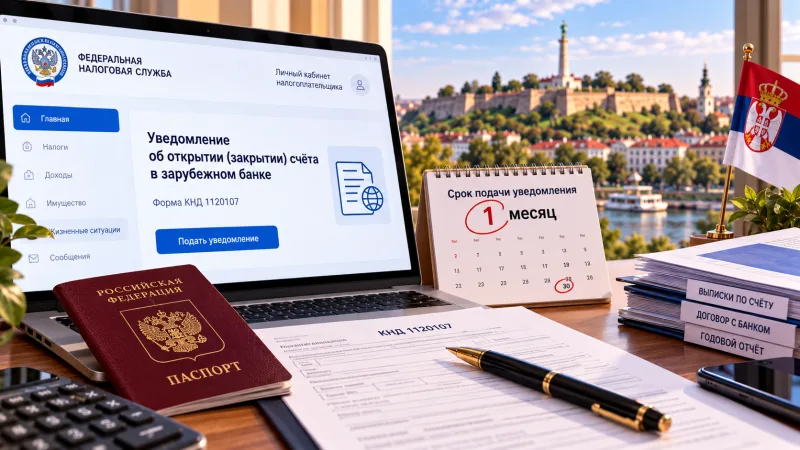
In short: what you need to know about your account and the tax office
If you have moved to Serbia and opened an account with a local bank, you take on obligations towards the Russian tax office — but not always. Everything hinges on one question: how many days of the calendar year you spent abroad. More than 183 days — you are not a Russian currency resident and do not have to report the opening of the account. Fewer — you must notify the tax office within a month and then report the movement of funds every year. Separately: if you hold Serbian residence and have been living abroad for a year or more, you have no account-related obligations at all. Below — how this works in numbers, what fines follow if you fail to notify, and how to file the report correctly.
The number 183 appears in two different rules and they must not be mixed. The first is the currency rule: it determines whether you must inform the Russian tax office about opening an account abroad and report the movement of funds. The second is the tax rule: it determines whether you are a Russian tax resident and at what rate you pay. Both are set out below, starting with the currency rule, because that is where most of the confusion lies.
Currency resident: count the days OUTSIDE Russia
The rule is simple and easiest to remember in this form: if during the calendar year you lived outside Russia for more than 183 days, you are exempt from the obligations relating to foreign accounts — you do not notify about opening, closing or changing account details, and you do not file the movement-of-funds report. If you spent fewer than 183 days outside Russia, you are a currency resident and the obligations apply: notify the tax office within 30 calendar days of the event and file the movement-of-funds report by 1 June of the year following the reporting year.
Important, and more important than any arithmetic: if you hold Serbian residence and have lived abroad for a year or more, you have no account obligations at all — neither to notify about opening an account nor to file the report. In that case there is no need to count days: you are not a currency resident. The obligations return only if you go to Russia and spend 183 days or more there in a calendar year.
Examples: you left for Serbia
- You left in May. From May to December you are outside Russia for about 245 days — more than 183. So you are exempt: neither notification nor report. The same applies in later years if you stay abroad.
- You left in September. From September to December you accumulate about 120 days outside Russia — fewer than 183. So for that year you are a currency resident and the obligations apply: notify of opening the account within 30 calendar days and file the report by 1 June of the following year. From the next year the situation changes: you will have spent a whole year abroad, and the obligations fall away.
- You left in September, then travelled to Russia and came back to Serbia. Add up all the days spent outside Russia in that calendar year, including that trip: if the total is fewer than 183, the obligations for that year remain.
- You hold Serbian residence and have a year abroad. There is nothing to count: no account obligations apply, and none will appear while you remain abroad.
The mechanics are as follows: what you compare is not 'how many days from departure to year-end in the country you moved to' but precisely the days outside Russia within the calendar year, from 1 January to 31 December. On 1 January the counter starts again.
If you hold Serbian residence: a separate exception
There is a rule more important than all this arithmetic. The law on currency regulation expressly excludes from the ranks of currency residents those Russian citizens who permanently live in a foreign state for at least a year — in particular those holding a residence permit issued by that state. So a Serbian residence permit plus living abroad for a year or more takes you out of the currency resident category altogether: the obligations to notify about accounts and to file the report do not arise at all, and there is no need to count days. The obligations return only if you go to Russia and spend 183 days or more there in a calendar year.
Two practical points about the report and about returning
First: the movement-of-funds report need not be filed if the total credited to the account during the whole reporting year did not exceed 600,000 roubles. There is also a separate relief for accounts in banks of the Eurasian Economic Union countries and states with which the tax service has automatic information exchange: with the same limit, no report is required. According to the tax service's explanations, those who were abroad for more than 183 days in total in the previous year are also exempt from filing the report. Second: if you did not file account notifications because you lived abroad, but by the year's outcome your total time abroad turned out to be fewer than 183 days — that is, you returned — the notifications must be filed. Put simply: once you are back and have spent enough time in Russia, do not wait for a letter from the tax office — put your accounts in order yourself.
Penalties
A late notification, or one not on the prescribed form, carries a fine of 1,000 to 1,500 roubles for an individual, and if no notification is filed at all — 4,000 to 5,000 roubles. The limitation period for currency violations is two years from the violation. Liability for the report is counted separately from liability for the notification.
What happens if you did not notify and you transfer money from Russia to Serbia
Having an account in Serbia is not prohibited, and transferring money from your own account in Russia to your own account in Serbia is allowed: transfers between your own accounts are permitted operations. Since 8 December 2025 the Bank of Russia has scrapped the limits on transferring foreign currency abroad for citizens altogether, so there is no longer a cap on the amount. But that does not remove the duty to notify of opening the account, and that is where the consequences begin.
The breach is not hard to detect: the bank sees the operation and passes the data to the tax office, and in addition the tax office receives information about foreign accounts through the international automatic exchange of financial information. So the assumption that it will go unnoticed does not work here.
- You did not notify at all. The fine for an individual is 4,000 to 5,000 roubles.
- You notified but late. The fine is 1,000 to 1,500 roubles.
- You did not file the movement-of-funds report. The fine is 2,000 to 3,000 roubles, for a late report 300 to 3,000 roubles, and for a repeat violation up to 20,000 roubles.
- The operation was classified as an unlawful currency operation. Then the fine is calculated from the amount: 20 to 40 per cent of the operation's value. That is the heaviest outcome, and it applies precisely to transfers made in breach of the rules.
A separate point about the transfer itself: the bank, as a currency control agent, is entitled to request documents about the foreign account and the operation. Without them the transfer may not be executed — so the money will not leave, and the questions from the tax office will still arrive. The practical conclusion: if the account is open and no notification has been filed, there is no point waiting for an inspection — it is cheaper to file a late notification and pay 1,000–1,500 roubles than to receive a 4,000–5,000 fine and questions about every operation.
The movement-of-funds report: what it is and how to file it
The movement-of-funds report is a document in which a resident shows the tax office how much money came in and went out through their foreign accounts during the calendar year and how much was left at the end of it. It is filed once, covering all foreign accounts together, not one report per account.
Form and deadline. For individuals the form is set by Government Decree No. 1365 of 12.12.2015, form code KND 1112520. The deadline is 1 June of the year following the reporting year: for 2025 you must report by 1 June 2026. Sole traders and companies use a different document — Decree No. 819 — and file it quarterly, not once a year.
What it covers. Accounts and deposits in foreign banks, brokerage, insurance and investment accounts with foreign organisations, and wallets in foreign payment systems. It shows credits, debits and balances, including transfers made without opening an account through foreign payment systems. Amounts are stated in the currency of the account, and the tax office converts them into roubles at the rate on the date of the operation. Bank statements and documents confirming the operations are attached.
When the report is not required. First: if you spent more than 183 days abroad in the calendar year — then you are not a currency resident and no report is needed. Second: if the account is held in a bank of an EAEU country or a country with which Russia has automatic exchange of financial information, and the total of credits, debits or the balance for the year does not exceed 600,000 roubles equivalent. Note that both conditions must be met together. If the country is not on the list of those "transparent" for the tax office, the report must be filed even with almost no activity on the account. For wallets in foreign payment systems the rule is its own: a report is needed only if total credits for the year exceeded 600,000 roubles.
How to file. The simplest way is through the taxpayer's personal account: the "Life situations" section, the item about a foreign bank account, then "Movement of funds report" — the system fills in the accounts you have notified. Other options: registered mail with an inventory, in person at the inspection, or via electronic document flow. If the account is new and the opening notification has not yet been filed, the notification comes first and the report after it.
What not to do. Fill in the wrong form. A wrong form is treated as failure to file the report, and that is a separate ground for a fine: 2,000 to 3,000 roubles for failure to file, 300 to 3,000 roubles for a late report and up to 20,000 roubles for a repeat violation.
Russian tax residency: a completely different rule
Tax residency has nothing to do with accounts and is counted differently: 183 days or more within 12 months running consecutively. That is a rolling window, not tied to the calendar year, and a day of stay is any day on which you were in Russia for at least part of the day. The consequences lie in the tax rate: for a non-resident the base rate is 30%, dividends 15%, while income under an employment contract with a Russian organisation, including remote work, is taxed on the same progressive scale as for residents.
Serbia: the 183 days apply here too, but on its own rules
Serbia treats you as its tax resident if you have a registered residence or the centre of your life and business interests here, or if you stay in the country 183 days or more within a 12-month period that begins or ends in the relevant tax year. Part of a day also counts as a full day. Then comes the most important point: Serbian residents pay tax on worldwide income, including income earned outside the country, while non-residents pay only on income from Serbia. The annual return is not required of everyone: it is filed if net income for the year exceeded three average annual salaries — for 2025 income that is 5,439,096 dinars. The 10% rate applies to taxable income up to 10,878,192 dinars, and 15% above that; there is a personal deduction of 725,213 dinars and a deduction of 271,955 dinars per dependent. For 2025 the return was due by 15 May 2026; if it is not filed, the tax authority assesses the tax itself, adds interest and starts misdemeanour proceedings.
How the two countries share one income
The double taxation treaty between Russia and Serbia determines which country may tax a particular type of income, and tax already paid is as a rule credited so that the same income is not taxed twice. The treaty alone is not enough: to apply the credit or exemption you must confirm your status with a document — a tax residency certificate. There is a separate article on obtaining one.
How to count the days in practice
Take your passport and count the days outside Russia from the entry and exit stamps; if there are no stamps, boarding passes, bookings and accommodation confirmations will do. Count the day of departure and the day of return as days abroad, as well as any day on which you were outside Russia for at least part of the day. Then compare with 183: more — you are exempt, fewer — you have obligations. It helps to keep a simple table: departure date, return date, number of days abroad and a counter for the current calendar year. Then you can see at any moment where you stand without reconstructing it afterwards.
Common mistakes
The first is counting days in the country you moved to instead of days outside Russia. The second is counting 'from departure to year-end' and forgetting the days abroad that occurred earlier in the same calendar year. The third is confusing currency and tax residency and concluding 'since I am not a resident, I owe nothing'. The fourth is forgetting that the first year after leaving may not yield the required 183 days, so the obligations for it remain. The fifth is not checking the Serbian side: having spent more than 183 days in Serbia you are most likely already its tax resident, obliged to declare worldwide income.
What to do step by step
Calculate the days outside Russia for the current calendar year and compare them with 183. Check whether you hold Serbian residence and have lived abroad for a year or more: if so, there are no account obligations at all. If you have no residence permit and have not reached 183 days abroad, notify of opening, closing or changing account details within 30 calendar days and prepare the report by 1 June, having checked the 600,000 rouble credit limit. Assess your Serbian status and the three-average-salaries threshold for the annual return. And keep the documents about your travels and transactions — they are what proves both the days and the amounts.
Data checked on 11 October 2026 against the rules in force in both countries. Rules change often, so before filing check the Russian tax service website and the Serbian tax administration.